
Client offboarding is the process of properly closing a client engagement so that work, deliverables, documentation, access, billing, communication, and responsibilities are all accounted for.
It is more than sending a final email or stopping work on a project.
A clean client offboarding process gives both sides a clear understanding of what was completed, what was handed over, what remains unresolved, who owns what, and what happens next. Without that structure, small details can easily fall through the cracks.
A practical client offboarding process usually covers:
- Confirming the end date and scope
- Reviewing outstanding work
- Preparing final deliverables
- Creating handoff documentation
- Transferring or revoking access
- Closing out billing and commercial details
- Communicating the final status
- Archiving the engagement
- Defining what happens next
The exact process will vary by business, service, contract, and client relationship. The goal is not to force every engagement into the same template. The goal is to make sure the important parts of the client exit are deliberately closed.
What Is Client Offboarding?
Client offboarding is the structured process of ending a client engagement and transitioning the work, information, responsibilities, and access to their appropriate next state.
That might mean handing completed work back to the client, transferring accounts to an internal team, preparing information for another provider, closing ongoing services, or simply documenting that the engagement has ended.
The important distinction is between stopping work and properly offboarding a client.
Stopping work can happen with a final deliverable and an email.
Offboarding requires you to look at the engagement as a whole.
For example, a marketing agency might have completed the agreed campaigns but still have:
- Reports that need to be delivered
- Client-owned accounts that need to be transferred
- Team access that needs to be reviewed
- An outstanding invoice
- Documentation that another provider may need
- Open requests that need a final decision
- Recurring services that need to be stopped
- Internal records that need to be archived
A proper client offboarding process brings those pieces together.
It also has both an operational and a relationship component. The operational side deals with work, files, access, ownership, billing, and records. The relationship side deals with communicating the final status and making the transition clear.
Client Offboarding vs. Project Closeout
Client offboarding and project closeout overlap, but they are not the same thing.
Project closeout focuses on completing and closing a specific project.
Client offboarding focuses on ending the broader client engagement or relationship.
For example, a client may finish a website redesign project but continue working with the agency on SEO. The website project needs to be closed out, but the client does not need to be offboarded.
The opposite can also happen. A client engagement may end while several projects, services, accounts, and responsibilities still need to be closed or transferred.
| Project Closeout | Client Offboarding |
|---|---|
| Closes a specific project | Ends the broader client engagement |
| Focuses on project scope and completion | Covers operational, commercial, and relationship closure |
| Reviews project deliverables | Reviews the entire client relationship |
| May happen while the client relationship continues | Usually marks the end of ongoing client work |
| Can be one part of offboarding | Can include multiple project closeouts |
If you are specifically closing a completed project rather than ending the broader client relationship, see the client project closeout process.
The distinction matters because a client engagement can contain multiple projects, ongoing services, accounts, documentation, and responsibilities. Treating every client exit as a simple project closeout can leave important pieces unresolved.
Why Client Offboarding Needs a Process
A client relationship can appear finished while important work remains open.
An informal exit often creates problems such as:
- Unfinished or unclear deliverables
- Missing documentation
- Confusing ownership
- Untransferred accounts
- Unnecessary access that remains active
- Unresolved billing
- Important information scattered across emails and conversations
- Unclear responsibilities after the engagement ends
- Poor final communication
- Internal records that were never properly closed
These problems are not always dramatic. More often, they are small omissions that become difficult to resolve later.

For example, a team may send the final report but forget to confirm where the client should find the supporting files. Another team member may still have access to a client account months after the engagement ends. A recurring subscription may continue because nobody included it in the closeout review.
A repeatable client offboarding workflow exists primarily to prevent things from falling through the cracks.
It also gives the team a consistent way to decide what needs attention instead of relying on memory or individual habits.
The process should be structured enough to be repeatable, but flexible enough to account for different contracts, services, access models, and client situations.
What a Good Client Offboarding Process Looks Like
A practical client offboarding process can be organized into nine stages:
- Confirm the ending
- Review remaining work
- Prepare final deliverables
- Organize documentation and handoff
- Transfer or close access
- Settle commercial details
- Communicate the close
- Archive the engagement
- Define what happens next
The sequence is useful because each stage answers a different question.
| Stage | Main question |
|---|---|
| Confirm | What exactly is ending, and when? |
| Review | What work is still open? |
| Deliver | What does the client need to receive? |
| Handoff | What context and information must be transferred? |
| Access | Who should own or access each system now? |
| Close | Are billing and commercial obligations resolved? |
| Communicate | Does everyone understand the final status? |
| Archive | Have the internal records been properly closed? |
| Next steps | What happens after the engagement ends? |
This is a framework rather than a universal rule. The appropriate sequence may change depending on the engagement agreement, service type, ownership arrangements, and systems involved.
Step-by-Step Client Offboarding Process
1. Confirm the End Date and Scope
Start by establishing exactly what is ending.
Review the relevant agreement, scope, and current commitments before deciding what belongs in the final workload.
Confirm:
- The agreed end date
- The relevant agreement or scope
- Any applicable notice requirements
- Work that remains in scope
- Work that is outside the final scope
- Responsibilities for unresolved items
- Any services that will continue separately
One important distinction is between confirmed commitments and informal requests.
A client may make a last-minute request during the final weeks of an engagement. That does not automatically make it a final deliverable.
Compare the request against the agreed scope and decide whether it should be completed, excluded, or handled separately.
A simple final scope review can prevent disagreements later.
2. Review Outstanding Work
Once the end date and scope are clear, create a factual picture of what remains.
Review:
- Open tasks
- Pending deliverables
- Outstanding approvals
- Unresolved client requests
- Items waiting for client input
- Work that should be completed
- Work that should be explicitly closed or excluded
Do not assume that everything is complete simply because the engagement is approaching its end date.
A final review should produce a clear status for every meaningful open item.
For each item, determine whether it will be:
- Completed before the end date
- Handed over to the client
- Waiting on client input
- Transferred to another provider or team
- Closed without completion
- Moved into a separate future engagement
This creates a much clearer basis for the final conversation.
3. Prepare the Final Deliverables
The final delivery should include everything the client is actually entitled to receive under the engagement.
Depending on the service, this could include:
- Final files
- Final reports
- Final versions of deliverables
- Supporting documentation
- Relevant historical information
- Source materials where applicable
- Account information where appropriate
- Instructions or context needed to use the delivered materials
The important point is to focus on a usable handoff, not simply sending files.
A folder containing dozens of files may technically satisfy a delivery requirement while still leaving the client unsure about what each file is, which version is final, or what they should do next.
Before delivery, check:
- What is being delivered?
- Is each item final?
- Is the format usable?
- Does the client know where to find it?
- Does the client need additional context?
- Does the agreement establish any ownership or source-file requirements?
Do not assume that every client automatically owns every underlying file, account, asset, or source material. Ownership depends on the agreement and engagement.
4. Create the Handoff Documentation
A client handoff should give the recipient enough context to continue without unnecessary confusion.
The handoff might include:
- What was completed
- Where important files are located
- Current status
- Outstanding items
- Relevant processes
- Account or system information
- Responsibilities after the handoff
- Important dates
- Recommended next actions
The goal is not to document every conversation that ever happened.
The goal is to capture the information someone reasonably needs to understand the current state of the work.
A useful handoff might answer:
What was done, where is everything, what is still open, who owns each responsibility, and what should happen next?
The handoff itself is one stage of the broader offboarding process. It should not replace the rest of the client exit.
For a deeper look at the handoff stage, see the client handoff process.
5. Transfer or Revoke Access
Access should be handled deliberately rather than as an afterthought.
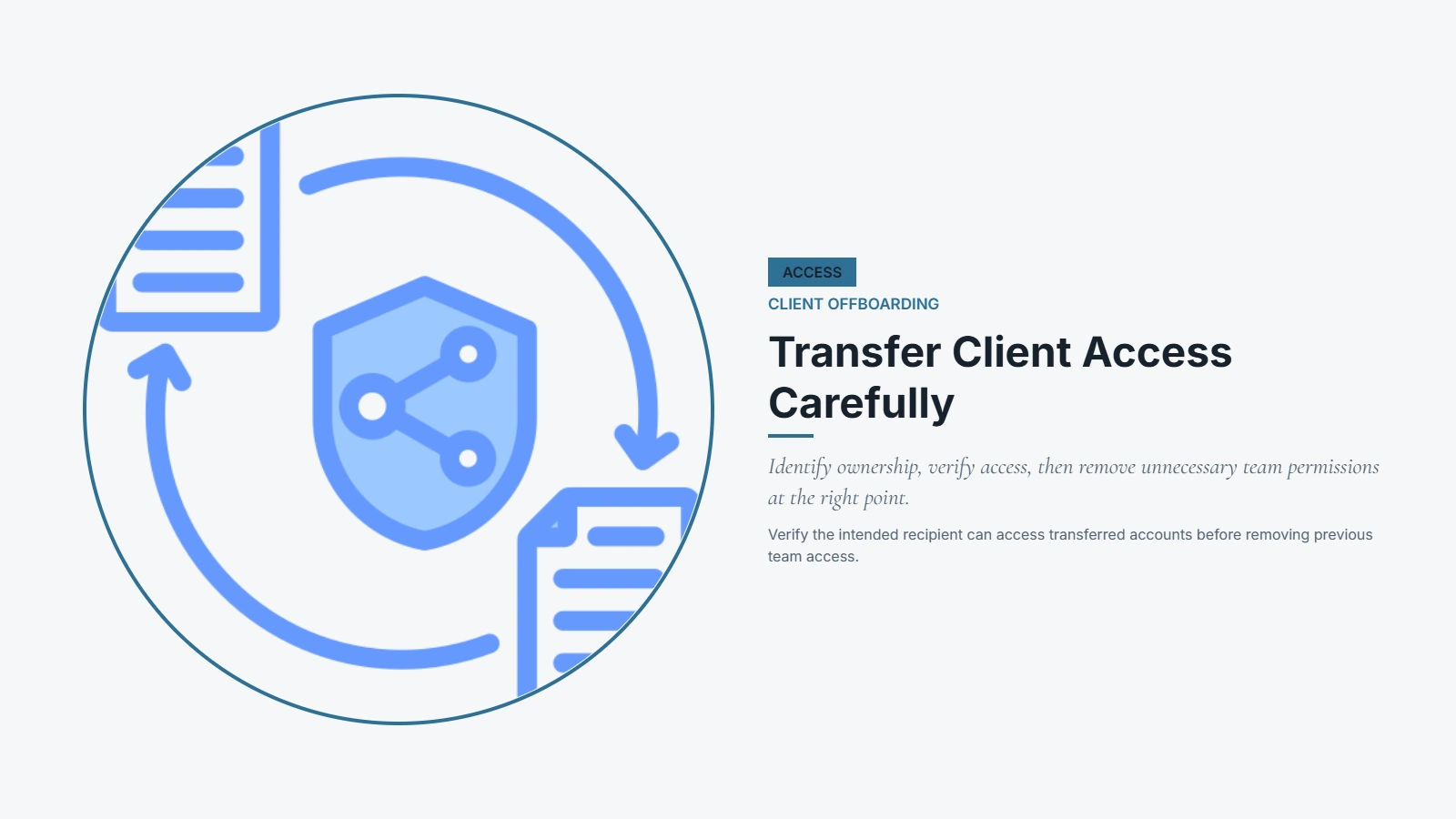
Start by identifying the systems, accounts, assets, and shared resources involved in the engagement.
Then follow this basic sequence:
Identify → transfer or confirm ownership → verify → revoke unnecessary access
Depending on the engagement, this can involve:
- Identifying client-owned accounts
- Transferring ownership where required
- Confirming the client can access what they need
- Reviewing shared resources
- Reviewing recurring access
- Removing unnecessary team access after the appropriate transfer point
- Recording what was transferred or closed
Verification matters.
If an account is transferred, confirm that the intended recipient can actually access it before removing the previous team’s access.
The appropriate process will vary by platform and ownership arrangement. Do not treat one access procedure as suitable for every system.
6. Close Out Billing and Commercial Details
The engagement should not be considered fully closed while important commercial details remain unresolved.
Review:
- Final invoices
- Outstanding balances
- Credits or adjustments where applicable
- Remaining contractual obligations
- Recurring billing
- Relevant subscriptions
- Confirmation of commercial closure
These items should be reviewed according to the engagement agreement rather than a universal rule.
For example, the final invoice timing may differ between a monthly retainer, fixed-fee project, consulting engagement, or another service arrangement.
The purpose of this stage is straightforward: make sure the operational end of the engagement and the commercial end of the engagement are aligned.
7. Have a Clear Closing Conversation
The final communication should give the client a clear picture of where things stand.
A useful closing conversation or final message can confirm:
- What has been completed
- What has been handed over
- Where final materials are located
- What remains unresolved
- Who owns remaining responsibilities
- What happens after the engagement
- Whether any action is still required from the client
This communication should be useful even when the client is leaving on neutral or negative terms.
The goal is clarity, not a forced attempt to turn every closing conversation into a testimonial, referral, or upsell.
If the relationship ended because the client was dissatisfied, a clear and professional close is still important. Keep the communication factual, document the agreed status, and avoid creating new ambiguity at the end of the relationship.
8. Archive the Engagement
Once the client-facing work is complete, close the engagement internally.
Depending on your business, this may include:
- Storing appropriate final records
- Preserving relevant project history
- Recording the engagement end date
- Recording unresolved items
- Documenting useful lessons
- Closing internal tasks
- Reviewing unnecessary access
- Organizing final communications and records
Client handoff and internal archival are different activities.
The handoff prepares information for the client or next provider.
The archive prepares your own records after the engagement has ended.
Do not assume that one automatically handles the other.
Also avoid making broad claims about data-retention requirements. What your business should retain, for how long, and under what conditions can depend on the agreement, industry, jurisdiction, and other factors.
9. Define What Happens Next
The end of an engagement does not always mean the same thing.
The next step could be:
- No further action
- Ongoing maintenance under a different arrangement
- A new engagement
- Future re-engagement
- Client-owned ongoing responsibilities
- An optional follow-up
Make the next state explicit.
If there is no further action required, say so.
If the client is responsible for maintaining something after the handoff, document that responsibility.
If future work is possible, it can be mentioned without turning the offboarding process into a sales interaction.
The important thing is to prevent ambiguity after the formal engagement ends.
Client Offboarding Checklist
Use this client offboarding checklist as the practical implementation layer of the process.
| Stage | Checklist |
|---|---|
| Confirm | Confirm end date, review scope, check applicable notice requirements, define remaining responsibilities |
| Review | Audit open work, pending deliverables, approvals, client requests, and unresolved items |
| Deliver | Prepare final files, reports, documentation, agreed materials, and relevant supporting information |
| Handoff | Document status, file locations, ownership, access, responsibilities, important dates, and next actions |
| Close | Review final invoice, outstanding balances, adjustments, subscriptions, and other commercial details |
| Communicate | Confirm completed work, handoff status, remaining responsibilities, and final next steps |
| Archive | Store appropriate records, close internal tasks, record the end date, and review unnecessary access |
Before marking the engagement complete, ask:
- Is the end date confirmed?
- Has the final scope been reviewed?
- Has all remaining work been accounted for?
- Has every agreed final deliverable been prepared?
- Can the client or next provider understand the handoff?
- Has ownership been clarified?
- Has necessary access been transferred?
- Has unnecessary access been reviewed?
- Has billing been addressed?
- Has the final status been communicated?
- Have internal records been closed?
- Is it clear what happens next?
If the engagement involved a specific project and you need a more detailed project-level checklist, see the client project closeout checklist.
Common Client Offboarding Mistakes
1. Starting Too Late
Problem: The team waits until the final day to begin reviewing what needs to happen.
Consequence: Deliverables, approvals, access transfers, and billing issues compete for attention at the same time.
Fix: Start the offboarding review early enough to identify dependencies and unresolved work before the actual end date.
2. Assuming All Work Is Complete
Problem: The engagement is treated as finished because the main project appears complete.
Consequence: Small open requests, approvals, reports, or administrative tasks remain unresolved.
Fix: Perform a final review of open work and give every meaningful item an explicit status.
3. Providing Files Without Enough Context
Problem: The client receives a collection of files without knowing what is final or how the files relate to the work.
Consequence: The client has to reconstruct the context themselves.
Fix: Organize the delivery and provide enough documentation for the recipient to understand what they received and what to do next.
4. Failing to Clarify Ownership
Problem: Both sides assume the other party owns an account, file, asset, or responsibility.
Consequence: Access and responsibility become difficult to resolve after the engagement ends.
Fix: Review ownership explicitly and document transfers where applicable.
5. Forgetting Access Transfer or Removal
Problem: Access is left unchanged because the team assumes someone else will handle it.
Consequence: The client may not have the access they need, while former team members may retain unnecessary access.
Fix: Identify the systems, transfer or confirm ownership, verify access, and then remove unnecessary access at the appropriate point.
6. Leaving Billing Unresolved
Problem: Operational work stops but invoices, balances, subscriptions, or adjustments remain open.
Consequence: The engagement is not commercially clear.
Fix: Include billing and other commercial details in the formal offboarding review.
7. Failing to Confirm the Final Status
Problem: Work simply stops without a clear final communication.
Consequence: The client may not know whether the engagement is actually closed or whether something is still expected.
Fix: Send a concise final status that confirms completed work, handoff status, outstanding responsibilities, and next steps.
8. Keeping Unnecessary Access Active
Problem: Former team members retain access after their involvement has ended.
Consequence: Access remains open without a clear operational reason.
Fix: Review access as part of offboarding rather than treating it as an unrelated administrative task.
9. Treating Every Client Exit the Same Way
Problem: A single checklist is applied without considering the engagement structure.
Consequence: Important differences in contracts, services, ownership, systems, and responsibilities are overlooked.
Fix: Use a consistent framework while adapting the actual steps to the engagement.
10. Closing the Engagement Without Recording What Happened
Problem: The team completes the client-facing work but leaves the internal record incomplete.
Consequence: Future team members have little context if the client returns or a question arises later.
Fix: Record the end date, relevant status, unresolved items, useful lessons, and other appropriate internal information before closing the engagement.
When a Shared Client Workspace Can Help
Client offboarding becomes harder when final work, documents, communication, status information, and client-facing materials are scattered across different places.
A shared client workspace can provide a clearer place for client-facing work throughout the engagement and during the transition out.
For example, a shared workspace can help provide:
- A common place for client-facing work
- Better visibility into outstanding items
- A clearer location for relevant information
- More continuity during a transition
- A central place for appropriate client-facing materials
This does not mean a shared workspace replaces the offboarding process.
You still need to decide what is being delivered, who owns each account or asset, what access should remain, what billing needs to be resolved, and what records should be retained.
The workspace is simply one way to keep the information involved in those decisions more organized.
For businesses exploring this approach, a client portal and shared client workspace can be useful when the problem is not the absence of information, but the fact that client-facing information is spread across too many places.
The right setup depends on how your business manages client work. Avoid assuming that a workspace automatically transfers accounts, revokes credentials, archives data, automates offboarding, sends notifications, handles billing, or performs security functions. Those capabilities should be evaluated separately.
Conclusion
Client offboarding is a structured close, not simply the point where communication stops.
A complete process should account for the end date and scope, remaining work, final deliverables, documentation, handoff, ownership, access, billing, communication, internal records, and what happens next.
The most useful approach is to combine a repeatable framework with enough flexibility to handle the specific engagement.
A simple process is:
- Confirm the end date and scope.
- Review outstanding work.
- Prepare the final deliverables.
- Create the handoff documentation.
- Transfer or revoke access.
- Close billing and commercial details.
- Have a clear closing conversation.
- Archive the engagement.
- Define what happens next.
Then use the checklist to make sure the important details are not missed.
For teams that struggle with scattered client-facing information during the engagement and transition, a shared client workspace can provide a clearer place to organize that work. The tool should support the process, not replace the decisions that make the offboarding complete.
Frequently Asked Questions
What is client offboarding?
Client offboarding is the structured process of ending a client engagement and closing the related work, deliverables, documentation, access, billing, communication, records, and responsibilities.
It is broader than simply stopping work or sending a final email.
Why is client offboarding important?
Client offboarding helps prevent unfinished work, missing documentation, unclear ownership, unnecessary access, unresolved billing, and unclear responsibilities from being overlooked when an engagement ends.
A repeatable process gives the team a consistent way to review these areas before considering the relationship closed.
What should be included in a client offboarding process?
A client offboarding process should generally include:
- End date and scope confirmation
- Outstanding work review
- Final deliverables
- Handoff documentation
- Ownership and access review
- Billing and commercial closeout
- Final communication
- Internal archival
- Next steps
The exact process should be adapted to the engagement agreement and service model.
When should you start offboarding a client?
Start the offboarding process early enough to identify outstanding work, approvals, access transfers, documentation, and commercial issues before the agreed end date.
The right timing depends on the engagement, its complexity, and any applicable agreement or notice requirements.
What should you include in a client handoff?
A useful client handoff can include:
- Completed work
- File locations
- Current status
- Outstanding items
- Relevant processes
- Account or system information
- Ownership and responsibilities
- Important dates
- Recommended next actions
The objective is to provide enough context for the client or next provider to continue without unnecessary confusion.
What should happen to client access when an engagement ends?
First identify the systems and accounts involved. Then transfer or confirm ownership where appropriate, verify that the intended recipient has what they need, and remove unnecessary team access at the appropriate point.
The exact procedure depends on the platform, ownership arrangement, and engagement terms.
How do you handle outstanding work during client offboarding?
Review every meaningful open item and decide whether it will be completed, handed over, closed, excluded from the final scope, or handled under a separate future arrangement.
Do not assume that every informal request automatically becomes a final deliverable.
What should be included in a client offboarding checklist?
A practical checklist should cover seven core areas:
- Confirm the ending
- Review outstanding work
- Deliver final materials
- Complete the handoff
- Close commercial details
- Communicate the final status
- Archive the engagement
You can expand individual checklist items depending on the type of service and client relationship.
What is the difference between client offboarding and project closeout?
Project closeout focuses on completing and closing a specific project. Client offboarding focuses on ending the broader client engagement or relationship.
A project can close while the client relationship continues. A client engagement can also end while several projects or workstreams still need to be closed or transferred.
Can a client portal help with client offboarding?
Yes. A client portal or shared client workspace can provide a clearer place for client-facing work, information, documents, and transition materials.
It does not replace the underlying offboarding decisions around scope, ownership, access, billing, communication, or internal records. Its value depends on how the business uses the workspace throughout the client relationship and during the transition.