When a client has not sent a required document, the best follow-up is not simply another “just checking in” message.
A useful follow-up makes the outstanding action obvious, gives the client enough context to act, and makes it easy to submit what is missing.
The problem is often the process rather than the client. The original request may have been unclear, the deadline may not have been specific, the submission location may have been difficult to find, or nobody may be tracking what is still outstanding.
A structured follow-up process helps you address the actual problem without repeatedly chasing the client.
Why Clients Miss Document Requests
A missing document does not necessarily mean the client is ignoring the request.
There are several reasons a document may remain outstanding:
- The original request was unclear.
- Too many documents were requested without enough structure.
- The deadline was unclear.
- The client does not know where to submit the file.
- The request was buried in another email or chat conversation.
- The client needs clarification before they can provide the document.
- The document is difficult for the client to obtain.
- Nobody is tracking what has already been received.
For example, a message that says “Please send the relevant documents” leaves the client to work out what “relevant” means.
A better request identifies the exact documents, explains what action is required, provides a deadline, and gives the client a clear submission method.
This distinction matters because sending more reminders will not necessarily solve a request that was unclear in the first place.
What to Check Before Following Up
Before sending another message, take a moment to confirm that a follow-up is actually necessary.
Check the following:
- The document is genuinely missing.
- The client has not already submitted it somewhere else.
- The original request was clear.
- The client received enough information to complete the request.
- The deadline has passed, or the timing makes a reminder appropriate.
- The client knows where the document should be submitted.
- The document is actually required.
This quick check can prevent unnecessary reminders.
It can also reveal that the problem is on your side. For example, the client may have sent the document in a different email thread, but the team did not record it.
A good follow-up process should reduce confusion, not create another layer of it.
How to Follow Up on Missing Client Documents
Once you have confirmed that a document is genuinely outstanding, use a consistent process.
1. Identify Exactly What Is Missing
Start with the specific document.
Avoid vague language such as:
“We’re still waiting for some documents.”
Instead, identify the outstanding item:
“We are still waiting for your signed service agreement.”
If several documents are missing, list them clearly.
For example:
- Signed service agreement
- Latest financial statement
- Current company registration document
Also distinguish between a missing document and an incomplete submission.
If the client submitted a file but a required page or section is missing, explain that rather than treating the entire document as absent.
This prevents unnecessary back-and-forth.
2. Reference the Original Request
Give the client enough context to understand what the reminder concerns.
They should not have to search through weeks of email or chat history to figure out which document you mean.
For example:
“Following up on the document request we sent earlier this week, we are still missing your latest financial statement.”
You do not need to repeat the entire original request. Just provide enough information to reconnect the reminder with the original task.
3. State the Required Action Clearly
Tell the client exactly what they need to do.
A useful follow-up should answer:
- What needs to be submitted?
- Is anything missing from an existing submission?
- Where should it be submitted?
- Is there anything else the client needs to do?
For example:
“Please upload the signed agreement to the client workspace so we can complete the review.”
The client should be able to read the message and know the next action without asking for clarification.
4. Include the Relevant Deadline
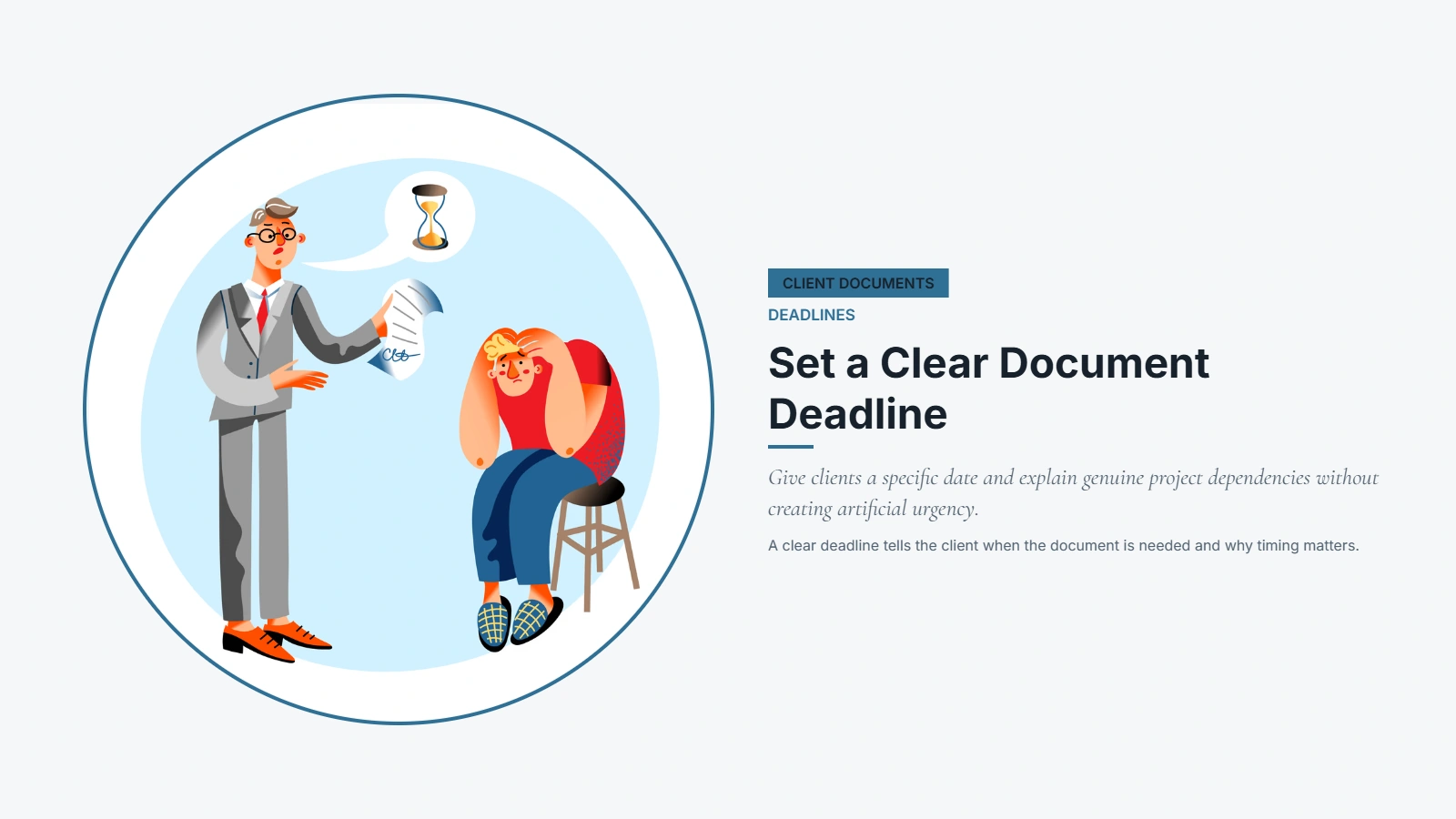
If the document is needed by a particular date, state that date.
For example:
“Please submit the signed agreement by September 20.”
If the missing document affects another part of the project, explain the genuine dependency:
“We need the signed agreement by September 20 so we can complete the review scheduled for September 23.”
This provides useful context without creating artificial urgency.
Avoid saying something is “urgent” unless there is a real consequence attached to the timing.
5. Send a Timely Reminder
Follow-up timing should be deliberate rather than reactive.
If you send several reminders too close together, the messages can become noise. If you wait too long, the missing document may already be affecting the project.
Establish reasonable follow-up intervals based on the importance of the document and the project timeline.
For example:
- Send the original request with a clear deadline.
- Check progress before the deadline if the document is important to upcoming work.
- Send a specific reminder when appropriate.
- Escalate if the document remains missing and is blocking work.
The exact timing will vary by business and project.
What matters is having a process rather than deciding from scratch every time.
6. Make the Next Step Easy
A reminder is much more useful when the client can immediately act on it.
Give them a clear submission location and avoid unnecessary steps.
For example:
“Please upload the document using the same client workspace where the original request is listed.”
Avoid making the client:
- Search through old messages.
- Work out which email address to use.
- Decide between several submission channels.
- Repeat information they have already provided.
- Ask your team where the document should go.
If document submission is a recurring part of your work, a consistent process can make follow-ups significantly easier.
For broader guidance on the initial collection process, see how to collect documents from clients.
7. Escalate When the Document Remains Missing
Sometimes a reminder does not solve the problem.
If the document remains missing, determine whether it is actually blocking work.
Ask:
- Can the project continue without it?
- Does another team member need the document?
- Is the client unable to obtain it?
- Does the request need clarification?
- Does someone else at the client’s organization need to provide it?
If the document is blocking work, explain the dependency clearly and clarify what happens next.
For example:
“We cannot complete the financial review until we receive the latest statement. If you need additional time to obtain it, please let us know and we can confirm the next available review date.”
If necessary, contact the appropriate person rather than sending the same reminder repeatedly.
Endless reminders usually indicate that the process needs to change.
What to Include in a Missing Document Follow-Up
A useful missing-document follow-up does not need to be long.
It should generally clarify the following:
| Element | What to include |
|---|---|
| Missing document | Name the exact document |
| Context | Reference the original request |
| Reason | Explain why it matters when useful |
| Deadline | Provide the relevant date or dependency |
| Required action | Tell the client what to do |
| Submission location | Explain where to send or upload it |
| Next step | Explain what happens after submission |
For example:
Subject: Outstanding document
Hi [Client Name],
Following up on the document request we sent earlier this week, we are still waiting for your signed service agreement.
Please upload the signed agreement by September 20 using the client workspace. We need it before we can complete the next stage of the project.
Once it has been submitted, we will review it and confirm the next step.
Thanks.
The important part is not the wording itself.
It is the structure.
The client can immediately see what is missing, what to do, when to do it, and what happens afterward.
Common Mistakes When Following Up on Missing Documents
Sending vague reminders
“Just checking in” does not tell the client what action is required.
Name the outstanding document.
Asking for several unrelated items without structure
If multiple documents are missing, group them into a clear list rather than putting everything into one paragraph.
Following up before the agreed deadline
If the client was given a reasonable deadline, avoid creating unnecessary pressure before it becomes appropriate to follow up.
Repeating the same message without additional context
If the first reminder did not work, simply sending the same message again may not solve the underlying problem.
Consider whether the client needs clarification, a different submission method, or a clearer explanation of the dependency.
Using multiple communication channels unnecessarily
A request sent through email, followed by a chat message, followed by another email can make it harder to determine which conversation contains the current status.
Keep the process as consistent as possible.
Failing to track what has been received
Without tracking, teams can accidentally request the same document twice or overlook another missing item.
Making the client guess what happens after submission
Tell the client what happens next when it matters.
For example:
“Once we receive the document, our team will review it and confirm whether anything else is required.”
Continuing to chase instead of addressing a recurring process problem
If the same type of document is repeatedly late, examine the process.
The issue may be:
- Poor timing.
- Unclear instructions.
- Difficult submission.
- Missing context.
- No visible status.
- An unrealistic deadline.
Improving the process can reduce the need for repeated follow-up.
A Simple Missing Document Follow-Up Checklist
Before sending a reminder, check:
- The missing document has been identified.
- The original request has been checked.
- The document has not already been submitted elsewhere.
- The deadline has been confirmed.
- The client has clear submission instructions.
- The follow-up timing is appropriate.
- The outstanding item is recorded.
- Any project dependency is understood.
- The escalation path is clear if the document remains missing.
This checklist is intentionally simple.
The purpose is to make follow-up consistent without creating another complicated administrative process.
When a Shared Client Workspace Can Help
Missing-document follow-ups become harder when requests and submissions are scattered across email threads, chat conversations, and separate file locations.
A shared client workspace can give both the business and client a clearer place to manage document-related work.
For example, it can help with:
- Keeping document requests and submissions in one shared location.
- Giving clients a clear place to find outstanding requests.
- Reducing scattered document-related conversations.
- Making required documents easier to identify.
- Giving the team better visibility into what remains outstanding.
The benefit comes from creating a clearer process around document requests, not simply from adding another tool.
If your workflow needs a dedicated place for client files, Riverton’s File Sharing solution may be relevant.
Editorial note: Verify current Riverton File Sharing functionality before publication. Do not claim automated follow-ups, reminders, notifications, integrations, security capabilities, or other functionality unless it has been confirmed.
A Simple Follow-Up Process
The overall process can be kept straightforward:
Identify the missing document
          ↓
Check the original request
          ↓
Confirm the deadline
          ↓
Send a specific follow-up
          ↓
Make submission easy
          ↓
Track the outstanding item
          ↓
Check whether work is blocked
          ↓
Escalate or adjust the process if necessary
The objective is not to send more messages.
It is to make each follow-up useful.
How to Reduce Repeated Document Follow-Ups
If your team regularly follows up on the same types of missing documents, look for patterns.
Review questions such as:
- Which documents are most often missing?
- Are clients asking the same questions about the request?
- Are deadlines being communicated clearly?
- Are clients using different submission methods?
- Can the team quickly see what is still outstanding?
- Are reminders being sent at a consistent point?
- Are documents requested early enough?
- Do clients understand why certain documents are needed?
The answers can reveal process problems that are easy to fix.
For example, if clients repeatedly fail to provide one particular document, you might:
- Add clearer instructions.
- Explain why the document is required.
- Request it earlier.
- Provide a clearer submission location.
- Add it to a standardized document request.
- Define when the follow-up should happen.
This approach is more sustainable than simply increasing the number of reminders.
For guidance on preventing document delays before they happen, see how to get clients to send documents on time.
Conclusion
Effective follow-up on missing client documents is about clarity and process, not simply sending more reminders.
First, confirm what is actually missing. Then make the required action clear, provide the relevant timing, and give the client an easy way to submit the document.
If the document remains missing, determine whether it is blocking work and change the approach when necessary.
For recurring requests, standardize the process so your team does not have to reinvent the follow-up every time.
The goal is simple: make it obvious what is missing, what the client needs to do, when it is needed, and what happens next.
A shared client workspace can also help when document requests, submissions, and related communication need a clearer place to live.
Frequently Asked Questions
How do you follow up on missing client documents?
Identify the exact missing document, reference the original request, state the required action, provide the relevant deadline, and make submission easy. If the document remains missing, determine whether it is blocking work and escalate appropriately.
How often should you follow up for missing documents?
Use reasonable intervals based on the deadline, project dependency, and importance of the document. Avoid sending multiple reminders too close together. The goal is consistent follow-up without creating unnecessary communication.
How do you remind a client to send a document professionally?
Be specific and neutral. Name the missing document, explain what action is required, provide the relevant deadline, and tell the client where to submit it. Avoid vague phrases such as “just checking in.”
What should you include in a missing document follow-up?
Include the missing document, enough context to identify the original request, the reason it is needed where useful, the deadline or dependency, the required action, the submission location, and the next step.
How do you follow up without sounding pushy?
Keep the message factual and focused on the outstanding action. Avoid artificial urgency and unnecessary repetition. If there is a genuine project dependency, explain it clearly rather than using pressure.
What should you do if a client still does not send the document?
First determine whether the client needs clarification or additional time. Then check whether the missing document is blocking work. If necessary, contact the appropriate person and explain the impact on the next step rather than continuing to send identical reminders.
How can you track missing client documents?
Use a simple tracking system that records which documents were requested, received, reviewed, or remain outstanding. The exact system can vary, but the team should be able to identify missing documents quickly.
How can businesses reduce repeated document follow-ups?
Review recurring delays and improve the underlying process. Clearer requests, better timing, simpler submission methods, visible tracking, and consistent follow-up can reduce the need for repeated chasing.
What is the best way to organize client document requests?
Keep the required documents, instructions, deadlines, and submission method clear and easy to find. For recurring workflows, standardize the request so clients receive a consistent process.
Can a shared client workspace help with missing documents?
Yes. A shared client workspace can give clients a clear place to find document requests and submit files while helping the business keep track of outstanding work. The usefulness depends on the specific workflow and verified capabilities of the workspace.