

A client handoff happens whenever responsibility for a client, project, or piece of work moves from one person or team to another.
That might mean sales handing a new client to onboarding, an account manager handing an account to a project manager, one specialist taking over from another, or a project moving from one stage to the next.
The mistake is treating the handoff as a simple transfer of contact details, files, or tasks.
The person taking over needs to understand what the client wants, what has already happened, what has been promised, what is still open, and what they need to do next.
That is what a good client handoff process provides.
What Is a Client Handoff Process?
A client handoff process is a defined way of transferring client context, work, and responsibility from one person or stage to another.
The process matters because the person taking over usually does not have the same knowledge as the person handing the work over.
The outgoing owner knows the history. They know which decisions were difficult, which requests are still unresolved, what the client cares about, and what was discussed in the last meeting.
The incoming owner does not.
Without a structured handoff, that knowledge can disappear.
A useful handoff should therefore answer five basic questions:
- What is the client trying to accomplish?
- What has been agreed?
- Where does the work stand now?
- What still needs attention?
- Who owns the next step?
If the person taking over can answer those questions without reconstructing the entire relationship from old emails and conversations, the handoff has done its job.
Why Client Handoffs Go Wrong
Most handoff problems are not caused by a lack of information. They are caused by information being incomplete, scattered, or poorly organized.
Imagine an account manager leaves the business and another person takes over the account.
The new account manager may have access to the CRM, project management system, email history, meeting notes, and shared files. Technically, they have plenty of information.
But they still may not know that the client is unhappy with a particular part of the service, that a deadline was informally moved, or that the client already rejected an approach two weeks ago.
The information exists. The context does not.
Handoffs also fail when sales, onboarding, or delivery teams document different versions of what was agreed. A client may have been promised something during a sales conversation that never made it into the project record.
Then the delivery team starts work based on one understanding while the client expects another.
Another common problem is ownership. A handoff says that someone else is taking over, but nobody clearly defines who owns the outstanding work, the client communication, or the next decision.
A good process addresses these problems before they become delivery problems.
What Should Be Included in a Client Handoff?
You do not need to transfer everything that has ever happened with a client.
You need to transfer the information that allows the next person to continue the work intelligently.
Client context
Start with the reason the client is working with you.
The receiving person should understand the client’s goals, main problems, important stakeholders, preferences, and any background that affects the relationship.
This is particularly important when the client has already spent time explaining their business.
For example, saying that a client “needs content” is not very useful. Explaining that they need content to support two priority services, have limited internal approval capacity, and need recommendations reviewed by the marketing manager gives the next person something they can act on.
The rule is simple: transfer context that changes how the work should be handled.
Scope and expectations
The next person also needs to know what the business has actually agreed to deliver.
That includes the scope, deliverables, deadlines, exclusions, client responsibilities, approval requirements, and any important commitments.
This is where informal promises can cause problems.
If a salesperson told the client that a report would be delivered every Friday, but the delivery team believes reporting happens monthly, the disagreement will eventually reach the client.
The handoff should make those commitments visible.
It should also distinguish between what is confirmed and what is still being discussed. An unresolved request should not accidentally become part of the agreed scope simply because it appears in a meeting note.
Current status
Context explains the relationship. Current status explains the work.
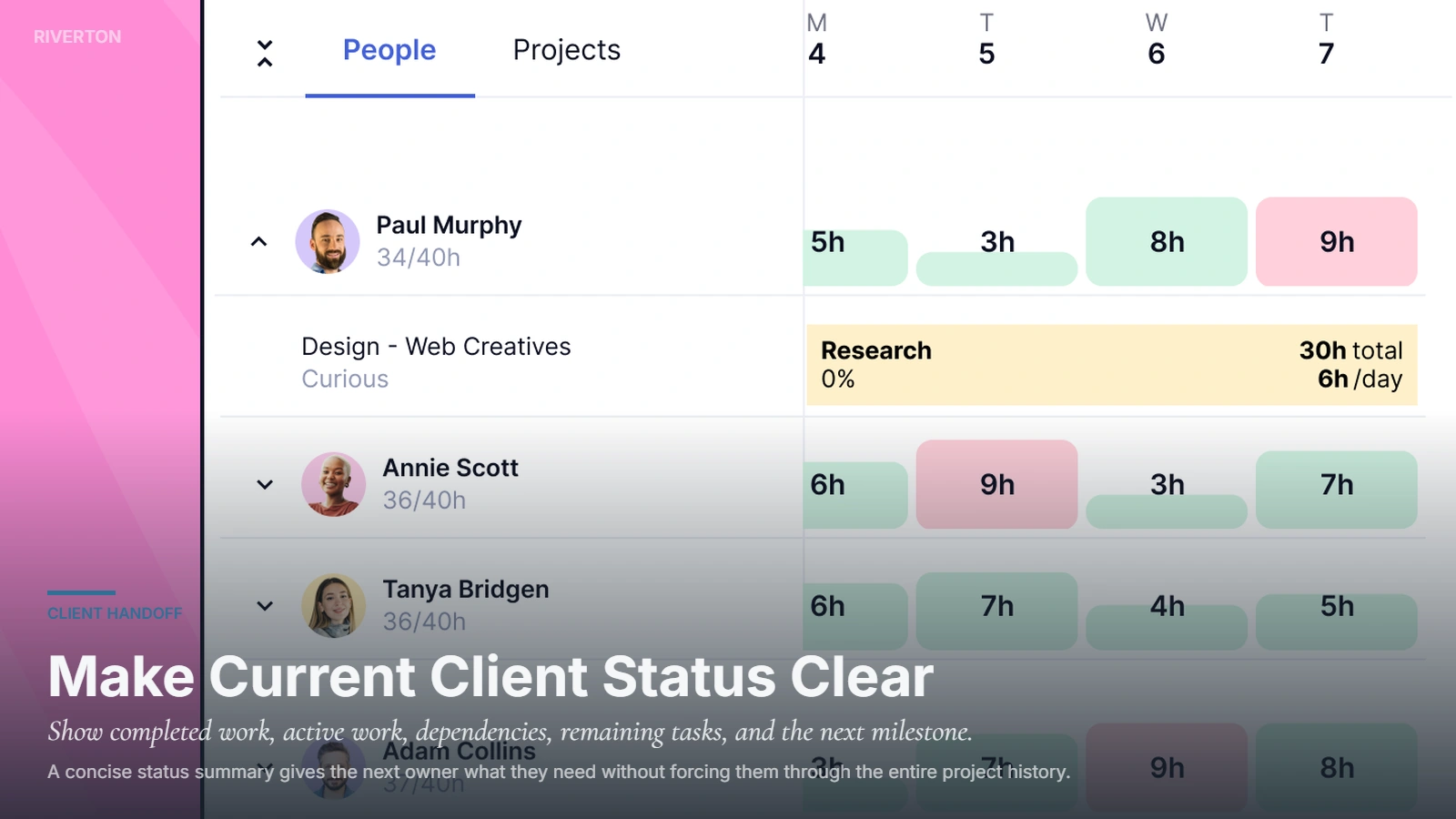
The person taking over should be able to see what has already been completed, what is currently being worked on, what is waiting for someone else, and what remains to be done.
This does not require a detailed history of every task.
A useful summary might say:
The initial audit is complete. The recommendations are being reviewed internally. The client has not yet provided the required access. The next milestone is scheduled for Friday, assuming access is received.
That is far more useful than giving someone a project folder and expecting them to work it out themselves.
Risks and open questions
A handoff should also make uncertainty visible.
If an approval is late, an asset is missing, a deadline is at risk, or the client has raised an unresolved concern, the incoming owner needs to know.
Hiding problems makes the handoff look cleaner but makes the next stage harder.
For every important open issue, establish who is responsible for resolving it.
There is nothing wrong with handing over a project that has an unresolved question. The problem is handing it over without telling the next person that the question exists.
Ownership and next steps
Finally, make the transition itself clear.
Who is taking over? Who remains involved? Who does the client contact? Who owns the outstanding work? What happens next?
A handoff should finish with an action, not just a status.
For example:
Sarah takes over the account today. She will contact the client tomorrow to confirm the revised milestone. James will remain responsible for the technical work.
Now everyone knows what changed and what happens next.
A Practical Client Handoff Process
The exact workflow will vary by business, but the underlying process can stay consistent.
1. Define why the handoff is happening
Start by identifying the trigger.
A handoff might happen because a new client has signed, onboarding is complete, an account manager has changed, a project has entered a new phase, or a team member is leaving.
This matters because the reason for the handoff determines what information the next person needs.
A new client moving from sales to onboarding needs different information from an existing client moving from one project manager to another.
2. Gather the relevant context
Next, gather the information the incoming owner needs.
Do not start by copying every note, email, or document you can find. Start by asking what the next person needs to understand the client and continue the work.
Review the client’s goals, stakeholders, preferences, important decisions, and relevant history.
If something no longer affects the relationship or current work, it probably does not belong in the handoff.
3. Confirm what has been agreed
Review the scope and expectations before responsibility changes hands.
Make sure the incoming owner knows what is included, what is excluded, what has been promised, and what the client is responsible for.
This is also the right time to resolve contradictions.
If the contract, project notes, and sales conversation appear to describe different expectations, do not pass the problem to the next person. Clarify it first where possible.
4. Establish the current state
Give the incoming owner a concise picture of where things stand.
They should know what is finished, what is underway, what is blocked, and what is waiting for the client or another team member.
This is where a short status summary is often more valuable than a large collection of historical notes.
5. Surface problems before they are inherited
List the issues that could affect the next stage.
A delayed approval, missing asset, difficult stakeholder, unresolved scope question, or upcoming deadline should be visible before the handoff is complete.
Assign responsibility for each important issue.
The incoming owner should not discover a major problem by accident after taking over the account.
6. Transfer ownership
Make the change in responsibility explicit.
The outgoing owner should know when they are no longer responsible. The incoming owner should know when they become responsible. The client should know who to contact when that matters.
For complex work, supporting team members and approval owners should also be identified.
7. Review the handoff
A simple handoff may only need a checklist review.
A complex account may benefit from a short conversation between the outgoing and incoming owners.
The purpose of that conversation is not to create another meeting for every client. It is to clarify context that would otherwise be difficult to capture.
The important decisions should still be recorded afterward.
8. Confirm the next action
Finish by identifying the next action, owner, and deadline where appropriate.
This is an important distinction.
A handoff is not complete because the information was sent. It is complete when the incoming owner understands the situation and knows what happens next.
Client Handoff Checklist
Use this as the minimum review before transferring responsibility.
| Check | What to confirm |
|---|---|
| Client context | Goals, contacts, stakeholders, preferences, relevant background |
| Scope | Services, deliverables, exclusions, client responsibilities |
| Expectations | Deadlines, approvals, communication requirements, commitments |
| Current status | Completed work, active work, outstanding work |
| Open items | Questions, blockers, dependencies, pending approvals |
| Files | Relevant documents, assets, and supporting information |
| Ownership | New owner, client contact, approvers, supporting team |
| Next action | Immediate action, owner, and deadline |
The checklist should be a safety net, not the entire process.
If completing the checklist requires someone to attach dozens of documents without explaining what matters, the underlying process still needs work.
Client Handoff Examples
The difference between a weak and strong handoff becomes clearer with a real scenario.
Weak handoff
John is taking over the account. The client is happy with the work so far. Everything is in the project folder.
It sounds reasonable, but it leaves the incoming owner with several unanswered questions.
What has actually been completed? What is still outstanding? What does the client expect next? Are there any concerns? Which deadline matters? Who approves the next deliverable?
The incoming owner now has to investigate.
Strong handoff
John is taking over the account today. The client is working toward increasing leads from two priority services. The initial research and first recommendations are complete. The next recommendations are waiting for client approval, which is due Thursday. The marketing manager is the main contact and the business owner gives final approval. The client has already rejected expanding into additional services this quarter. John owns client communication from today, while Maria remains responsible for delivery. The next action is to follow up on the pending approval Thursday morning.
This version is not dramatically longer.
It is simply more useful.
The incoming owner knows the goal, current status, important context, ownership, risk, and next action without reading the entire account history.
Client Handoffs at Different Stages
A client handoff process should be consistent without pretending that every handoff is identical.
The information required changes depending on where the client is in the relationship.
| Handoff | What matters most |
|---|---|
| Sales → Onboarding | Goals, scope, commitments, stakeholders, expectations |
| Onboarding → Delivery | Requirements, assets, approvals, setup, next steps |
| Account Manager → Project Manager | Client context, current work, deadlines, risks, communication history |
| Team Member → Team Member | Current status, decisions, files, blockers, next actions |
| Project Phase → Project Phase | Completed work, outstanding work, dependencies, upcoming milestones |
| Delivery → Closeout | Final deliverables, outstanding items, approvals, closeout requirements |
This is why a single giant client handoff template often becomes difficult to use.
Instead, define the information that matters for each common type of transition.
The standard should be consistent. The details should be relevant.
Common Client Handoff Mistakes
Treating the handoff as a file transfer
A folder can contain everything and still tell the incoming owner almost nothing about what matters.
Fix: Provide a short context summary alongside supporting files.
Sending everything
Dumping an entire email history and every project document onto the next person does not create clarity.
Fix: Separate important context from supporting information. The incoming owner should not have to become an investigator.
Leaving verbal commitments undocumented
Promises made in sales calls, meetings, or informal conversations can become client expectations.
Fix: Document commitments that affect scope, timing, responsibilities, or deliverables.
Hiding unresolved problems
A clean-looking handoff that excludes current problems only moves the problem downstream.
Fix: Make blockers, risks, and open questions visible and assign them to an owner.
Making the client repeat themselves
When the incoming team asks questions the client has already answered, the internal handoff has failed.
Fix: Preserve useful client context and make it available to the people taking over.
Leaving ownership vague
“The team will handle it” does not identify who is actually responsible.
Fix: Name the owner and define the next action.
Relying on meetings alone
A meeting can transfer context, but people forget conversations and new team members may not attend them.
Fix: Record the important decisions and actions in a place the relevant people can access.
Starting before the handoff is ready
If critical information is missing, starting work immediately can create avoidable rework.
Fix: Use a simple readiness check before responsibility changes.
How to Make Client Handoffs Repeatable
The best client handoff process is not the one with the most fields.
It is the one people can follow consistently.
Start by defining the situations that normally trigger a handoff in your business. Then establish the minimum information required for each situation.
For example, every handoff might require client context, scope, current status, open issues, ownership, and next steps. A more complex transition might also require a live review.
Give the outgoing owner responsibility for preparing the handoff. Give the incoming owner responsibility for reviewing it. That creates a clear point at which the transition is considered complete.
It is also worth reviewing the process when the same problems keep appearing.
If clients repeatedly have to explain their goals after a handoff, the problem may be missing context.
If teams repeatedly disagree about scope, the problem may be poor documentation.
If projects repeatedly stall after a transition, the problem may be unclear ownership or missing next actions.
Those patterns tell you where the process needs improvement.
For more on building repeatable workflows, see How to Standardize Client Processes.
Client Handoff vs. Client Onboarding
Client handoff and client onboarding often happen close together, but they solve different problems.
A handoff transfers context and responsibility.
Onboarding gets the client ready to work successfully.
For example, when sales hands a signed client to onboarding, the handoff should give the onboarding team the information it needs to understand the client and what was agreed.
The onboarding process then takes over the actions required to get the engagement started.
Keeping those responsibilities separate makes the workflow easier to design and measure.
When a Shared Client Workspace Helps
A client handoff becomes harder when important information is spread across email, CRM notes, project management tools, documents, chat, forms, and separate task lists.
A shared client workspace can help by giving the people involved in the engagement a common place to access relevant information and continue the work.
The benefit is not simply having another place to store files.
The useful part is having the context around those files. When a new person takes over, they should be able to understand what the client needs, what is happening now, what needs attention, and what happens next.
That can be particularly useful when several people work with the same client or when responsibility changes multiple times during an engagement.
It is not necessary for every business. A small team with a simple client workflow may be able to achieve the same result with well-organized records.
The important thing is the process. A shared workspace can support that process, but it does not replace clear ownership or good documentation.
For businesses looking for a dedicated client-facing workspace, Riverton’s Client Portal is one option to consider.
Final Takeaway
A client handoff should make the next person capable of continuing the work without starting from zero.
That requires more than transferring a contact record or pointing someone toward a project folder.
The incoming owner needs to understand the client’s goals, what has been agreed, where the work stands, what remains unresolved, who owns each responsibility, and what happens next.
A simple client handoff process can provide that structure without becoming another administrative burden.
Define the trigger, transfer the relevant context, confirm the current state, surface risks, assign ownership, and finish with a clear next action.
Do that consistently, and client transitions become much less dependent on individual memory or scattered information.