
Waiting for clients to send required documents can slow down an entire project.
A missing contract, financial statement, brand asset, ID document, access detail, or other file can leave work waiting on one small dependency. The usual response is to send another reminder, then another, until the deadline becomes urgent.
But repeated chasing is often a sign of a process problem rather than a motivation problem.
If clients are unclear about what they need to send, where to send it, when it is due, or why it matters, delays become much more likely.
A better approach is to make document requests clear, easy to complete, visible, and tied to a specific deadline. Then track what has been received and follow up before a missing document becomes a project problem.
Why Clients Do Not Send Documents on Time
Client document delays usually happen because the request creates unnecessary friction.
Common causes include:
- The client does not know exactly what is required.
- The request contains too many items or unclear instructions.
- No specific deadline is provided.
- The client does not understand why the documents are needed.
- Documents are difficult to locate or submit.
- Requests get buried in email or chat.
- There is no consistent follow-up process.
- The client has to search through previous conversations to understand what is still missing.
This does not mean clients are unwilling to cooperate. In many cases, the process simply makes it harder than necessary to take the next action.
For example, compare these two requests:
| Weak request | Clear request |
|---|---|
| “Please send over the documents we need.” | “Please send your 2025 financial statements, current company registration document, and signed agreement.” |
| No deadline | “Please submit these by September 20.” |
| No submission instructions | “Upload the files using the shared client workspace.” |
| No explanation | “We need these before we can complete the financial review.” |
| Client has to ask what is missing | Required documents are listed together |
The second request gives the client a clear action, deadline, and reason.
That is the standard to aim for.
What a Better Client Document Request Looks Like
Before asking a client for documents, make sure the request answers the basic questions they are likely to have.
1. What do I need to send?
List each required document clearly.
Avoid phrases such as:
- “Send your paperwork.”
- “Send the relevant files.”
- “Please provide everything you have.”
Instead, name the specific documents.
If there are several files, group them logically:
- Company information
- Financial documents
- Brand assets
- Project files
- Signed agreements
A clear list reduces back-and-forth questions and makes it easier for the client to check whether they have completed the request.
2. What exactly should I do?
Give plain-language instructions.
If the client needs to upload a PDF, say so. If a document needs to be signed, explain that. If they need to provide information rather than a file, make that distinction clear.
Do not assume the client understands your internal terminology.
3. When is it due?
Give a specific date rather than saying:
- “As soon as possible”
- “When you get a chance”
- “Before we start”
A specific deadline makes the request actionable.
If the deadline affects another part of the project, explain that connection.
For example:
Please send the requested documents by September 20 so we can complete the review scheduled for September 23.
Now the client understands both the deadline and the dependency.
4. Where should the documents be submitted?
Give the client one obvious place to submit the files.
The more places they have to choose from, the easier it is for information to become scattered.
A good document request should make the submission path obvious without requiring the client to search through old emails or messages.
5. What happens after submission?
Tell the client what happens next when useful.
For example:
Once we have all three documents, we will review them and confirm whether anything else is required.
This gives the client closure and makes the process easier to understand.
For broader guidance on gathering client information, see how to collect documents from clients.
How to Get Clients to Send Documents on Time
A reliable process does not depend on sending more reminders. It makes the request easier to understand, complete, and track.
1. Make the Request Specific
Start by identifying exactly what you need.
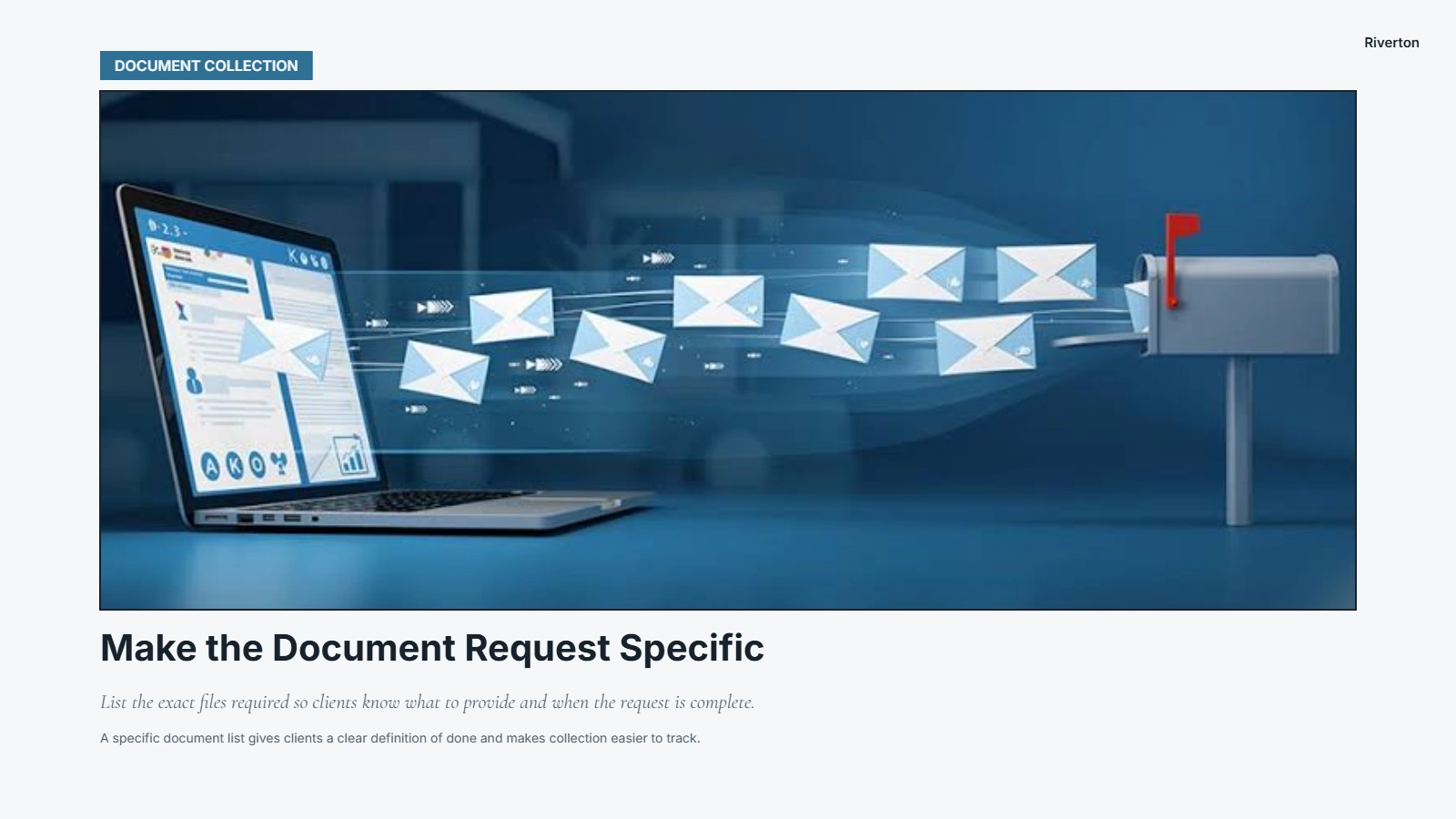
Instead of asking for “all relevant documents,” create a short list of the actual items required.
For example:
- Signed service agreement
- Current company registration document
- Latest financial statement
- Brand guidelines
- Primary contact details
If several documents belong together, group them into categories.
This gives the client a clear definition of “done.”
It also makes tracking easier for your team because you can see exactly which items have been received and which remain outstanding.
2. Explain What Is Needed and Why
Clients are more likely to act when they understand what the requested documents are needed for.
You do not need to write a long explanation. A short piece of context is usually enough.
For example:
We need your latest financial statement to complete the initial review and prepare the next stage of the project.
If a document is blocking another task, say so.
This helps the client understand that the request is part of the workflow rather than an arbitrary administrative task.
3. Set a Clear Deadline
A document request without a deadline can easily become a low-priority task.
Use a specific date:
Please submit the documents by September 20.
If timing is important, explain the dependency:
We need these by September 20 to keep the September 24 project start on schedule.
Give reasonable notice whenever possible.
If you know that your team will need several days to review the documents, build that time into the request rather than setting a deadline that leaves no room for processing.
4. Make Document Submission Easy
The submission process should require as few unnecessary steps as possible.
Avoid making clients:
- Search through old emails.
- Figure out which email address to use.
- Send files through several different channels.
- Rename files according to complicated internal rules.
- Repeat information they have already provided.
Give them a clear submission location and simple instructions.
If your process requires multiple documents, keep the request and submission instructions together so the client can easily refer back to them.
5. Track What Has Been Received
You should be able to answer one question quickly:
What are we still waiting for?
A simple tracking system can distinguish between:
| Status | Meaning |
|---|---|
| Not requested | The document has not yet been requested |
| Requested | The client has been asked to provide it |
| Received | The client has submitted the document |
| Needs review | The document has been received but still needs checking |
| Incomplete | The submitted information is missing something |
| Not applicable | The document is not required for this client |
The exact statuses can vary by business.
The important part is visibility.
Tracking prevents duplicate requests and helps your team identify missing documents before they cause delays.
6. Follow Up Before the Deadline Becomes a Problem
Do not wait until the deadline has passed to discover that an important document is missing.
Set a consistent point for checking outstanding requests.
A reminder should make the remaining action obvious.
Instead of:
Just following up on this.
Try:
A quick reminder that we are still waiting for your signed agreement and latest financial statement. Please submit both by September 20 so we can keep the next project stage on schedule.
A useful follow-up tells the client:
- What is still missing.
- When it is needed.
- Why the deadline matters.
- What they need to do next.
For the process to use when documents are already missing, see how to follow up on missing client documents.
7. Handle Missing or Late Documents Consistently
When a document is late, your team should know what happens next.
For example:
- Identify the missing document.
- Check whether it blocks other work.
- Send a specific follow-up.
- Update the request status.
- Adjust the next step if the document affects the timeline.
- Review the process if the same delay happens repeatedly.
The goal is not to create a complicated escalation system.
The goal is to avoid improvising every time a client misses a document deadline.
If the same type of document is repeatedly late, look at the request process itself.
Maybe the instructions are unclear. Maybe the client receives the request too late. Maybe the submission method is inconvenient. Or perhaps the document is being requested at a point in the workflow where the client does not yet understand why it matters.
Fixing the underlying process is usually more effective than simply sending more reminders.
Common Mistakes When Requesting Client Documents
Some document-request habits create delays even when the client is willing to cooperate.
Asking for documents one at a time
If you already know that five documents will be required, asking for them individually can create unnecessary back-and-forth.
A complete list is often easier to understand and act on.
Using vague requests
“Please send the relevant paperwork” leaves too much interpretation to the client.
Name the documents instead.
Giving no deadline
Without a specific deadline, the client may not know when the request becomes urgent.
Sending requests across multiple channels
One document might arrive by email, another through chat, and another as an attachment to a different conversation.
This makes it harder for everyone to know what has been received.
Failing to track received documents
If your team cannot quickly see what is complete and what is missing, duplicate requests become more likely.
Following up without saying what is missing
“Just checking in” forces the client to figure out what you are asking about.
State the outstanding document or action directly.
Waiting until the deadline has passed
If a missing document will affect delivery, discovering the problem after the deadline is already missed leaves fewer options.
Making the client responsible for understanding an unclear process
Clients should not have to figure out your internal workflow.
The request should tell them what they need to do.
Client Document Request Checklist
Use this quick checklist before sending a document request.
Before sending
- Required documents are clearly listed.
- Instructions are easy to understand.
- The deadline is specific.
- File requirements are included where genuinely necessary.
- The submission method is clear.
- The client understands why important documents are needed.
- The next step is clear.
- Outstanding documents can be identified later.
- Follow-up timing has been defined.
- Important project dependencies are visible.
A simple request should allow the client to answer three questions without asking your team for clarification:
What do I need to send?
When do I need to send it?
Where do I send it?
If those answers are obvious, you have removed much of the unnecessary friction from the process.
When a Shared Client Workspace Can Help
Email can work for simple document requests, but it becomes harder to manage when a client relationship involves multiple files, tasks, conversations, and deadlines.
A shared client workspace can give both sides a clearer place to manage client work.
For document collection, that can mean:
- Keeping document requests in one shared location.
- Giving clients a clear place to submit required files.
- Making outstanding requests easier to identify.
- Reducing dependence on scattered email threads.
- Keeping the document request connected to the wider client workflow.
The value is not simply having another place to upload files.
The value comes from creating a clearer process around the request.
If your business needs a dedicated place for client file exchange, you can explore Riverton’s File Sharing solution.
Note: Confirm the current File Sharing functionality before publication and avoid claiming automatic reminders, notifications, integrations, security features, or automation unless those capabilities are verified.
A Simple Client Document Process
A reliable document-request workflow can be summarized as:
Identify required documents
          ↓
Create a clear request
          ↓
Set a specific deadline
          ↓
Give one clear submission method
          ↓
Track what has been received
          ↓
Follow up on outstanding documents
          ↓
Review late or recurring requests
          ↓
Continue the dependent work
How to Reduce Client Document Delays Over Time
If document delays happen repeatedly, do not treat every occurrence as a separate client problem.
Look for patterns.
Ask:
- Which documents are most frequently late?
- Are clients asking the same clarification questions?
- Are requests being sent too close to the deadline?
- Are clients using multiple submission methods?
- Does your team know what has already been received?
- Are reminders being sent consistently?
- Are certain documents requested before the client understands why they are needed?
- Does the same type of delay repeatedly block delivery?
These questions can reveal where the process itself needs improvement.
For example, if clients repeatedly miss the same document, you might:
- Add a clearer explanation to the request.
- Move the request earlier in the workflow.
- Make the submission method easier.
- Group it with related documents.
- Add a clear deadline.
- Define when the first reminder should be sent.
The goal is to make the next request better rather than simply increasing the number of follow-ups.
Conclusion
Getting clients to send documents on time starts with making the process easy to understand and easy to complete.
Clear requirements, plain-language instructions, specific deadlines, simple submission methods, visible tracking, and consistent follow-up can remove much of the friction that causes document delays.
If your team regularly spends time chasing missing files, look at the process before assuming the solution is more reminders.
Standardize recurring document requests, make outstanding items visible, and give clients one clear path from request to submission.
When a shared workspace makes that process easier to manage, it can also give clients a clearer place to find requests and submit required documents.
The objective is simple: make it obvious what the client needs to send, when it is needed, and where it should go.
Frequently Asked Questions
How do you get clients to send documents on time?
Make the request specific, provide a clear deadline, explain important dependencies, give clients an easy submission method, track what has been received, and follow up before the deadline becomes a problem.
How should you ask a client for documents?
List the exact documents you need, explain anything the client needs to know about the files, provide a specific deadline, and tell them exactly where and how to submit the documents.
How far in advance should you request client documents?
Request documents early enough to allow the client to gather them and your team to review them before the documents are needed. The right lead time depends on how difficult the documents are to obtain and how much review your team needs.
What should a client document request include?
A good request should include the required documents, clear instructions, a specific deadline, the submission method, relevant context, and the next step after submission.
How do you follow up when a client has not sent documents?
Keep the follow-up specific. Identify the missing documents, restate the deadline, explain any important dependency, and provide a clear next action. Avoid vague messages such as “just following up.”
How can you make it easier for clients to submit documents?
Reduce unnecessary steps and give clients one clear submission location. Avoid making them search through old conversations or figure out which channel to use.
How do you track missing client documents?
Use a simple status system that shows which documents have been requested, received, reviewed, or are still outstanding. The system should make it easy for the team to identify what remains incomplete.
What should you do when a client misses a document deadline?
Identify whether the missing document affects other work, follow up with the client about the specific outstanding item, update the status, and adjust the workflow if necessary. If the same issue happens repeatedly, improve the process rather than simply sending more reminders.
How can businesses reduce client document delays?
Make requests clearer, set specific deadlines, simplify submission, track outstanding documents, follow up consistently, and review recurring sources of friction in the document-collection process.
Can a shared client workspace help with document collection?
Yes. A shared client workspace can provide a clearer location for client requests and document submission, while making outstanding work easier for the business to identify. Its usefulness depends on the specific workflow and capabilities available.